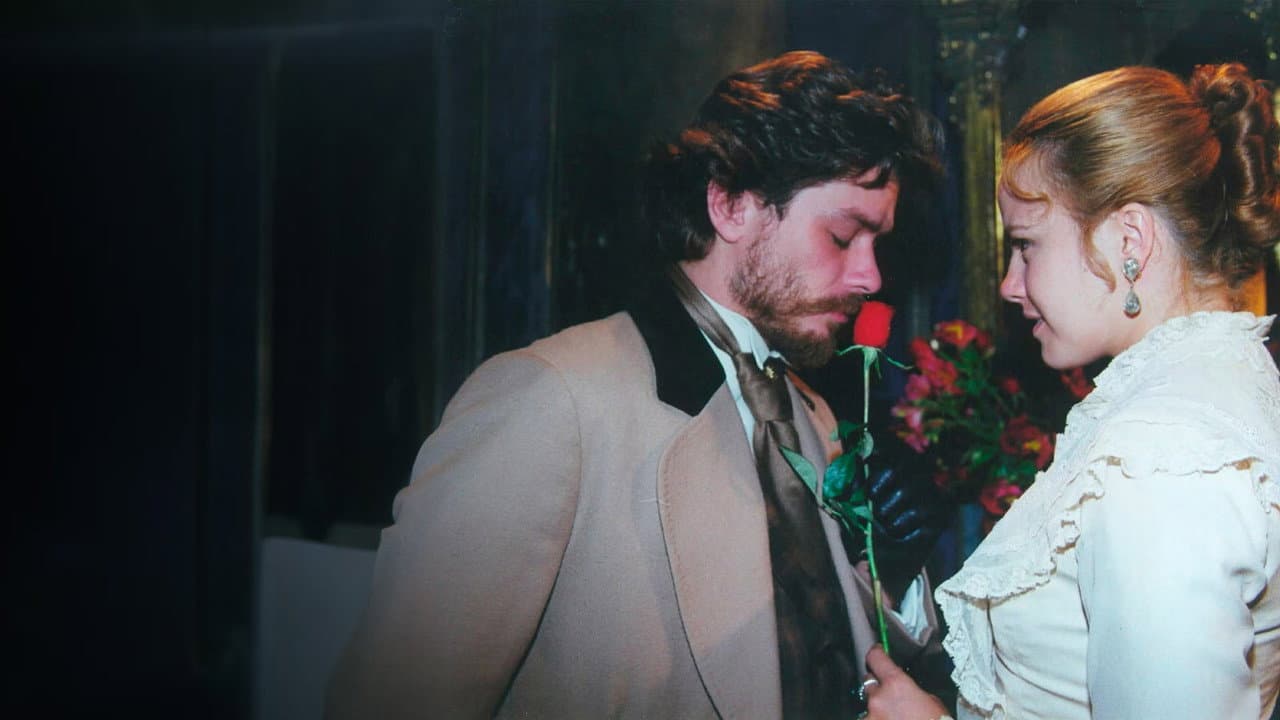
Pedro da Maia, meets a beautiful woman called Maria Monforte with whom he gets married despite his father's objection. The marriage produces a son, Carlos Eduardo, and a daughter. Some time later, Maria Monforte falls in love with Tancredo and runs away to Italy with him, taking her daughter along. When Pedro finds out, he goes with his son to his father's house where he commits suicide. Carlos stays at his grandfather's house and is educated by him. Carlos, becomes a doctor and opens his own office. Later he meets a gorgeous woman, Maria Eduarda. The two fall in love and have dozens of nights together. Eventually Carlos finds out later that Maria lied to him about her past and he starts fearing the worst. In the end, Carlos finds out that Maria is his sister. He informs her that they are siblings and that they cannot live like this anymore. Carlos, to forget his tragedies, goes for a trip around the world.
DirectorsLuiz Fernando Carvalho, Del Rangel, Emílio Di Biasi
WritersMaria Adelaide Amaral, Eça de Queirós, João Emanuel Carneiro, Vincent Villari
Episode 1
Jan 9, 2001
No description available.
Episode 2
Jan 10, 2001
No description available.
Episode 3
Jan 11, 2001
No description available.
Episode 4
Jan 12, 2001
No description available.
Episode 5
Jan 16, 2001
No description available.
Episode 6
Jan 17, 2001
No description available.
Episode 7
Jan 18, 2001
No description available.
Episode 8
Jan 19, 2001
No description available.
Episode 9
Jan 23, 2001
No description available.
Episode 10
Jan 24, 2001
No description available.
Episode 11
Jan 25, 2001
No description available.
Episode 12
Jan 26, 2001
No description available.
Episode 13
Jan 30, 2001
No description available.
Episode 14
Jan 31, 2001
No description available.
Episode 15
Feb 1, 2001
No description available.
Episode 16
Feb 2, 2001
No description available.
Episode 17
Feb 6, 2001
No description available.
Episode 18
Feb 7, 2001
No description available.
Episode 19
Feb 8, 2001
No description available.
Episode 20
Feb 9, 2001
No description available.
Episode 21
Feb 13, 2001
No description available.
Episode 22
Feb 14, 2001
No description available.
Episode 23
Feb 15, 2001
No description available.
Episode 24
Feb 16, 2001
No description available.
Episode 25
Feb 20, 2001
No description available.
Episode 26
Feb 21, 2001
No description available.
Episode 27
Feb 22, 2001
No description available.
Episode 28
Feb 27, 2001
No description available.
Episode 29
Feb 28, 2001
No description available.
Episode 30
Mar 1, 2001
No description available.
Episode 31
Mar 2, 2001
No description available.
Episode 32
Mar 6, 2001
No description available.
Episode 33
Mar 8, 2001
No description available.
Episode 34
Mar 9, 2001
No description available.
Episode 35
Mar 13, 2001
No description available.
Episode 36
Mar 14, 2001
No description available.
Episode 37
Mar 15, 2001
No description available.
Episode 38
Mar 16, 2001
No description available.
Episode 39
Mar 20, 2001
No description available.
Episode 40
Mar 21, 2001
No description available.
Episode 41
Mar 22, 2001
No description available.
Episode 42
Mar 23, 2001
No description available.

Filipe Manuel Neto
@FilipeManuelNeto
**A competent and well-made miniseries that, however, has some minor flaws to consider.** I don't think I'm saying anything new if I say that Brazilian series and soap operas are one of the best and most interesting in the South American universe, and the best known internationally, in Portuguese language. This does not denote any demerit of Portuguese or even Angolan TV productions..., but it does show the strength of the Brazilian TV market and the Brazilian capacity to export and sell what is made by its television stations. Things that Portuguese dramatic production insists on not learning, despite the excellent actors and technical staff. This miniseries, in about fifty episodes, is already a few years old, but it was one of those that made an impression on me for its continuous nods to Portugal, despite having been a great failure in its country of origin. Personally, it doesn't surprise me: based on literary works by the outstanding Portuguese writer Eça de Queirós ("Os Maias", the author's masterpiece, and also "A Capital" and "A Relíquia"), the series brings content that Portuguese know very well because the writer is Portuguese and his books are a mandatory subject to study in Portuguese schools! I don't know if Eça de Queirós has the same weight and importance in Brazilian classrooms, but I do know that Brazilians are not particularly fond of reading, especially if such a book is as long, as massive and as intricate as “Os Maias”. Therefore, just for this, the series was doomed in its own country. The series is quite good, and it's worth spending an hour a day to watch it in full. Despite dealing with quite intense themes, such as adultery and incest, I didn't see particularly inappropriate scenes (perhaps because Portuguese TV makes some cuts to the intense scenes that Brazilian material brings?) and I was quite pleased with the overall quality. The only thing that really disappoints me is including plot and characters from other books, instead of devoting all the attention to "Os Maias". I think it would have been a better rewarded effort, and one that would do more justice to the literary work of Eça de Queirós who, in this book, not only tells a good novel, but also criticizes the thought, customs and way of life, indolent and decadent, of Lisbon's high society, which he, as a nobleman and diplomat, knew very well. The actors are good, with the best interpretations given by Ana Paula Arósio, Fábio Assunção, Walmor Chagas, Selton Melo, Simone Spoladore and Osmar Prado. Personally, I didn't like Otávio Muller, I think he made his character excessively caricatured and forced. I believe that the series would have gained in quality if some of the actors (the most relevant ones) were Portuguese and spoke without an accent, but I can understand the reasons why this did not happen: Brazilians, in general, have a huge difficulty in understanding Portuguese when they speak. They are not used to listening to us! Although most of the series was filmed in a studio, it features several scenes set in filming locations near Rio and Minas Gerais, as well as in Portugal. The temporal details were meticulously thought out, and the recreation of the environments and times is well done, especially if we consider that it is material for TV. Finally, and before finishing, a word about the soundtrack, by John Neschling: if the incidental music is excessively dramatic and that can be kitsch, the good songs and melodies of the disappeared Portuguese group Madredeus largely compensate for it, and they end up imposing themselves in songs like “O Pastor”, “Ilhas dos Açores” or “Haja o que Houver”. I only missed one thing: more period songs, which would insert us more into the 19th century atmosphere.